
Geography

Kota Kinabalu previously known as Jesselton is the state capital of Sabah, Malaysia. It is located on the northwest coast of Borneo facing the South China Sea. Being the capital city of Sabah, Kota Kinabalu plays a major role in both the political and economic welfare of the population of the entire state.
Located on the west coast of Sabah. Kota Kinabalu lies on a narrow flatland between the Crocker Range to the east and the South China Sea to the west. There are 6 islands off the coast of the city, with the largest being Gaya Island and other smaller inhabited islands named Sapi Island, Manukan Island, Sulug Island, Mamutik Island, and Sepanggar Island.
The Kota Kinabalu city center consists of mostly businesses and the government, including Karamunsing, the port area (Tanjung Lipat), Signal Hill, Kampung Air, Sinsuran, Segama, Asia City, Gaya Street (Old Town), Bandaran Berjaya, Api-Api, Sutera Harbour and Sembulan. Kota Kinabalu is relatively isolated from the rest of the country; it is around 1,624 kilometers from Kuala Lumpur in Peninsular Malaysia and 804 kilometers from Kuching in Sarawak. Covering the five Islands opposite the city (Gaya, Sapi, Manukan, Sulug, and Mamutik) and their surrounding seas is The Tunku Abdul Rahman National Park. Its name was bestowed to honor the first prime minister of Malaysia. The park is a popular destination for both visitors and locals.
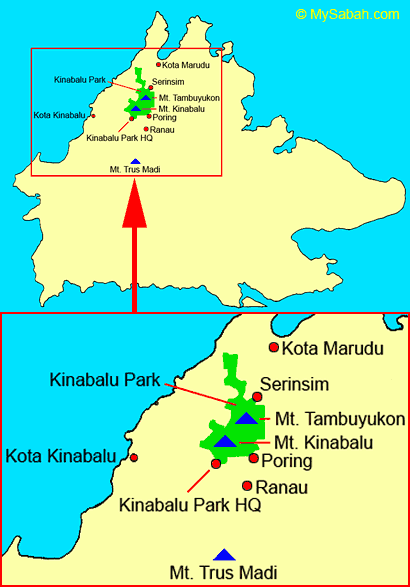
Mount Kinabalu, also known as Gunung Kinabalu in Malay, is the highest point in Malaysia and the Malay Archipelago, rising up to 4,095 metres. It is situated on the Malaysian island of Borneo in the state of Sabah. After Puncak Jaya in New Guinea and Mauna Kea in Hawaii, it is the third tallest mountain on an island on the earth. Mt. Tambuyukon is located between the boundaries of Kinabalu Park. It is dubbed as the third highest mountain in the country at 2,579 meters high situated to the north of Mount Kinabalu, the highest point in Malaysia.
With Kinabalu's climate, there are various amounts of biodiversity found. UNESCO World Heritage Convention estimated that there are around 5,000 to 6,000 vascular plant species found in Kinabalu, which include representatives from more than half the families of all flowering plants. Kinabalu's ecosystems are diverse, with six vegetation zones ranging from lowland rainforest to alpine scrub at 4,095m. The land also has a high level of fauna variety and is an important center for endemism.